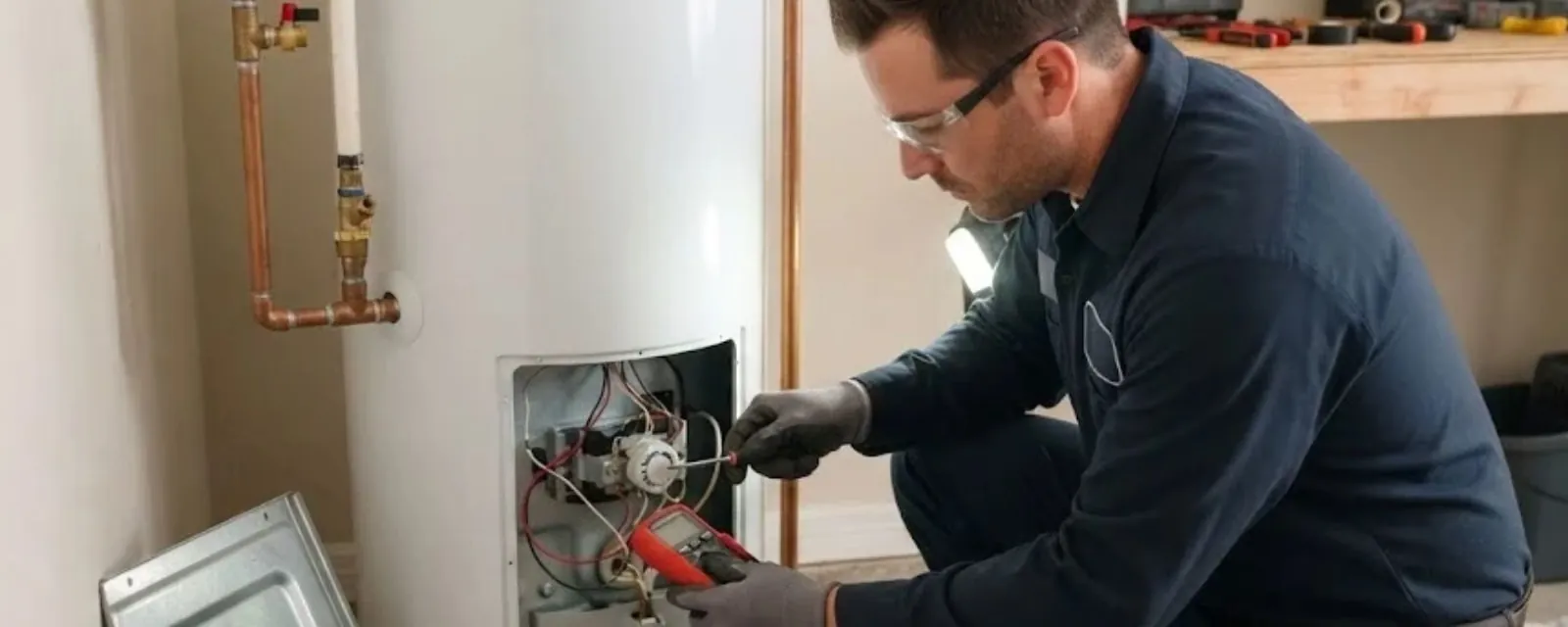
Read the symptom first
What the heater is doing narrows the cause before anyone opens a panel.
No hot water at all.
Electric units often have a tripped breaker, a failed upper element or a bad thermostat. Gas units may have a pilot or igniter fault.
Lukewarm water.
A failed lower element, a broken dip tube or a thick layer of sediment keeps the tank from holding heat.
Rumbling or popping.
Mineral sediment under the heating surface traps steam. The noise is a warning that the tank is working harder than it should.
Water at the base.
A leak from a fitting or relief valve can be repaired. A leak from the tank shell itself means replacement.
Water heater emergency: what to do before we arrive
A tank that is leaking steadily or a gas smell near the heater is urgent. Act on the safest item first.
- Gas smell: leave the home and call your gas utility or 911 before calling us.
- Active leak: close the cold water valve on top of the heater and open one hot tap upstairs to relieve pressure.
- Electric unit: turn off its breaker before touching any wet area.
- Move anything stored near the base to dry ground, and keep children away from hot discharge.
Do not plug a relief valve discharge pipe. It exists to release pressure safely.
Repair or replace: the honest test
Age, condition and cost decide it. A tank in the first eight to ten years with a failed element, thermostat or valve is usually worth repairing. A tank that is leaking from the shell, or one with a long history of repairs, is not.
Anode rods protect the steel tank from corroding. If the rod was never checked and the water is rusty, we tell you plainly that the tank is near the end. If it is a one-part repair on a young unit, we repair it.
When the answer is replace, we explain that on the page for water heater replacement and give you a clear price before anything is removed.
Common repairs by heater type
| Heater type | Frequent faults | Typical fix |
|---|---|---|
| Electric tank. | Failed element, thermostat or tripped limit switch. | Replace the part and test the circuit. |
| Gas tank. | Thermocouple, igniter, gas control valve. | Replace the part and check venting and draft. |
| Tankless. | Scale in the heat exchanger, error codes, flow sensor. | Descale, clean filters, replace the sensor, see tankless service. |
| Any tank. | Dripping relief valve or leaking drain valve. | Replace the valve and check pressure. |
Gas appliance work in Prince George's County must be done by a WSSC Water-licensed plumber or gasfitter.
Cold shower and a full day ahead?
Call the 24/7 line. When parts are on the truck we can often finish the same day.
Why Greenbelt water is hard on heaters
WSSC Water's 2023 tap report lists a yearly average hardness of 140 mg/L for Potomac plant water and 65 mg/L for Patuxent water. That is roughly 8 and 4 grains per gallon. The harder the water, the faster sediment collects on the bottom of a tank.
Flushing a tank once a year removes loose sediment and keeps elements from burning out early. If you have never flushed yours, tell us when you call and we will check how heavy the buildup is.
Boiler and radiator heat questions
Some older Prince George's County homes heat with a boiler rather than a furnace, and some tenants ask about it when the hot water also goes out. A boiler is a heating appliance with its own pressure, venting and controls, so it is not the same job as a hot water tank.
Tell us what the system is when you call. If a boiler also supplies your domestic hot water, we need the make and age. We also tell you when a boiler repair needs a heating technician rather than a plumber, so you are not paying for the wrong visit.
Standards that govern water heaters
Gas storage water heaters are built to ANSI Z21.10.1, and electric storage heaters to UL 174. Temperature and pressure relief valves are tested to ANSI Z21.22. Those standards are why we replace a relief valve instead of capping or plugging one, and why a discharge pipe has to be left open and pointed downward.
Gas work follows NFPA 54, the National Fuel Gas Code, as adopted locally by WSSC. Always check that the person doing gas work holds the required WSSC license.
What changes the cost of a repair
Repair prices are given before work starts.
Want your real number? Sudden leaks that damage floors may be covered by homeowners insurance, but gradual seepage from a rusting tank often is not. Call (301) 936-0389 and we will explain the price before work starts.
A short check before you call
- Look at the breaker panel for a tripped switch on electric heaters.
- Check whether the gas pilot or display is lit on gas heaters.
- Feel the tank outlet pipe. If it is cold, the unit is not heating at all.
- Look under and around the tank for moisture and write down where it is.
- Note the model sticker. The manufacture date helps us judge repair value.
Frequently asked questions
Yes. Our emergency line runs 24 hours a day. If the tank is leaking, shut the cold supply valve first, then call, and we arrange an appointment as soon as one is available.
In Montgomery and Prince George's counties, WSSC Water says most plumbing work, including gas work such as water heater replacements, must be done by a WSSC Water-licensed plumber or gasfitter. You can ask any plumber for the license number and verify it with WSSC licensing at 301-206-8588.
Many tanks serve eight to twelve years, and hard water and skipped maintenance shorten that. The unit's date code tells you how old yours is.
A broken dip tube, a failed lower element or heavy sediment usually reduces the usable hot water in a tank. A diagnosis finds which one.
Dripping from the relief valve line can mean excess pressure or a worn valve. Replacing the valve is a small repair, but a steady flow needs a prompt visit.
Yes. Scale, filters and sensors cause most tankless faults. Our tankless page explains flushing and repair.